Models of Bending Elements
There are several models relevant to the modeling of bending (dipole) elements available in ImpactX. The models include:
Sbend - linear model of a sector bend (using a symplectic matrix)
ExactSbend - fully nonlinear model of a sector bend (using a nonlinear symplectic map)
CFbend - linear model of a combined-function bend (using a symplectic matrix)
ExactCFbend - fully nonlinear model of a combined-function bend (using symplectic integration)
DipEdge - model of a dipole entry or exit fringe field (both linear and nonlinear models available)
ThinDipole - thin kick model of a sector bend (using a nonlinear symplectic map)
To clarify the model input parameters, the figures below illustrate the basic dipole geometry.
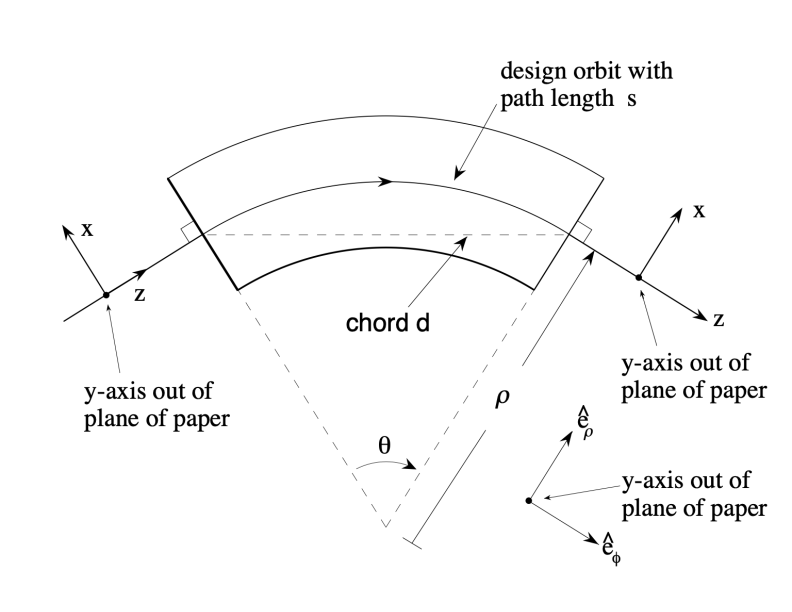
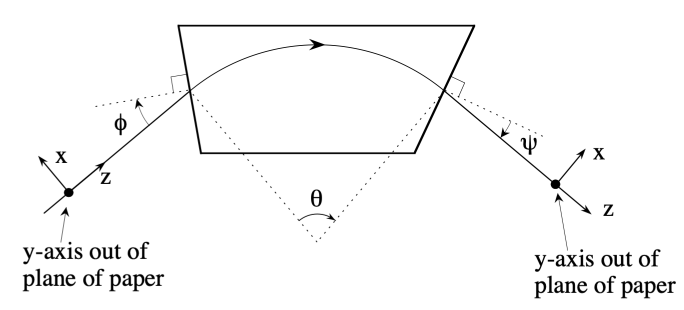
Fig. 20 (Upper) Geometry of a basic sector bend. (Lower) Geometry of a general bend with non-normal entry and exit angles. These figures are excerpts from the MaryLie Manual, Figs. 6.2.1 and 6.4.1, respectively.
Bending is assumed to occur in the x-z plane. A positive bend angle \(\theta\) and positive radius of curvature \(\rho\) corresponds to bending in the -x direction (clockwise about the vertical y-axis).
The effects of non-normal pole face entry and exit, along with other dipole fringe field effects, are applied using DipEdge elements. For example, a symmetric parallel-faced (rectangular) bend can be modeled by using entry and exit angles \(\phi=\psi=\theta/2\).